Updated for 2026 • 12 minute read
If you're wondering how much to charge for house cleaning services, you're not alone.
Pricing is one of the hardest parts of running a cleaning business. Charge too little and every job becomes less profitable than you expected. Charge too much and you risk losing customers before you ever earn their trust.
The good news is that pricing doesn't have to be guesswork.
The most successful cleaning businesses don't randomly pick prices or copy competitors. They use repeatable pricing systems that account for home size, service type, local market conditions, and the amount of work required.
This guide walks through exactly how to build those prices.
Quick Answer
Most residential cleaning businesses charge using one of three pricing models:
Flat-rate pricing (recommended)
Square-foot pricing
Hourly pricing
Typical residential cleaning prices in 2026 are:
Service | Typical Price |
|---|---|
Standard Cleaning | $120–$300 |
Deep Cleaning | $200–$500+ |
Move Out Cleaning | $250–$700+ |
Post Construction | $350–$1,000+ |
Actual pricing depends heavily on:
Square footage
Number of bathrooms
Home condition
Pets
Location
Cleaning frequency
Why Most Cleaning Businesses Lose Money
One of the biggest mistakes new cleaning companies make is copying someone else's prices.
Just because another company charges $180 doesn't mean you should.
Their cleaners may earn different wages.
Their insurance costs may be different.
Their travel times may be shorter.
Their homes may simply be easier to clean.
Instead, your pricing should reflect your costs, your market, and the value you provide.
The goal isn't to be the cheapest.
The goal is to build a profitable business that can continue serving customers for years.
What Actually Determines Your Price?
Professional cleaning companies typically adjust pricing based on several variables.
1. Home Size
Larger homes generally require more labor.
Many companies use square footage as the foundation of their pricing.
Typical residential ranges:
Cleaning Type | Price Per Sq Ft |
|---|---|
Standard | $0.10–$0.16 |
Deep | $0.15–$0.25 |
Move Out | $0.20–$0.35 |
Post Construction | $0.25–$0.40 |
These are starting points—not rules.
2. Cleaning Type
Not all cleaning jobs require the same amount of work.
A recurring maintenance clean is dramatically different from a first-time deep clean.
The more labor involved, the higher your price should be.
3. Frequency
Recurring customers create predictable revenue.
Because of that, many companies offer discounts.
Typical discounts include:
Weekly: 10–15%
Biweekly: 5–10%
Monthly: 0–5%
One-Time: No discount
4. Home Condition
Two homes with identical square footage can require completely different amounts of work.
Some companies use what we call a Dirty Meter to account for this.
Examples include:
Light dusting
Heavy pet hair
Grease buildup
Excess clutter
Long-overdue deep cleaning
These conditions should increase your quote.
5. Pets
Pets almost always increase cleaning time.
Hair.
Odors.
Nose prints.
Extra vacuuming.
Many companies either:
Charge a flat fee per pet
Increase overall pricing slightly
The important thing is consistency.
6. Local Market
A 2,500-square-foot home in Nashville should not cost the same as one in San Francisco.
Labor costs vary.
Insurance varies.
Customer expectations vary.
Your pricing should reflect your local market—not national averages.
Flat Rate vs Hourly Pricing
This is one of the biggest debates in the cleaning industry.
Hourly Pricing
Pros
Easy to calculate
Flexible
Cons
Customers focus on time instead of value
Rewards slower cleaning
Makes quoting difficult
Flat Rate Pricing
Pros
Easier for customers to understand
More predictable revenue
Faster quoting
Better customer experience
Cons
Requires good estimating
Most established residential cleaning businesses eventually transition toward flat-rate pricing.
Common Pricing Mistakes
Charging by Guesswork
Pricing should be systematic—not based on intuition.
Forgetting Travel Time
Drive time is still labor.
Underpricing Deep Cleans
Deep cleans almost always take significantly longer than recurring visits.
Never Raising Prices
Costs change.
Your pricing should too.
Ignoring Home Condition
Not every 2,000-square-foot home is equally dirty.
Example Quote
Let's estimate a standard cleaning.
2,200 sq ft
Standard clean
Biweekly
2 pets
Moderately dirty
Starting estimate:
2,200 × $0.12 = $264
Biweekly discount:
-$26
Pets:
+$20
Home condition adjustment:
+$40
Estimated Price:
$298
Every business will have slightly different numbers, but the process stays the same.
Make Pricing Consistent
The biggest advantage successful cleaning businesses have isn't charging more.
It's charging consistently.
When every quote follows the same pricing system:
Customers receive fair pricing.
Employees know what to expect.
Profit margins become predictable.
Growth becomes easier.
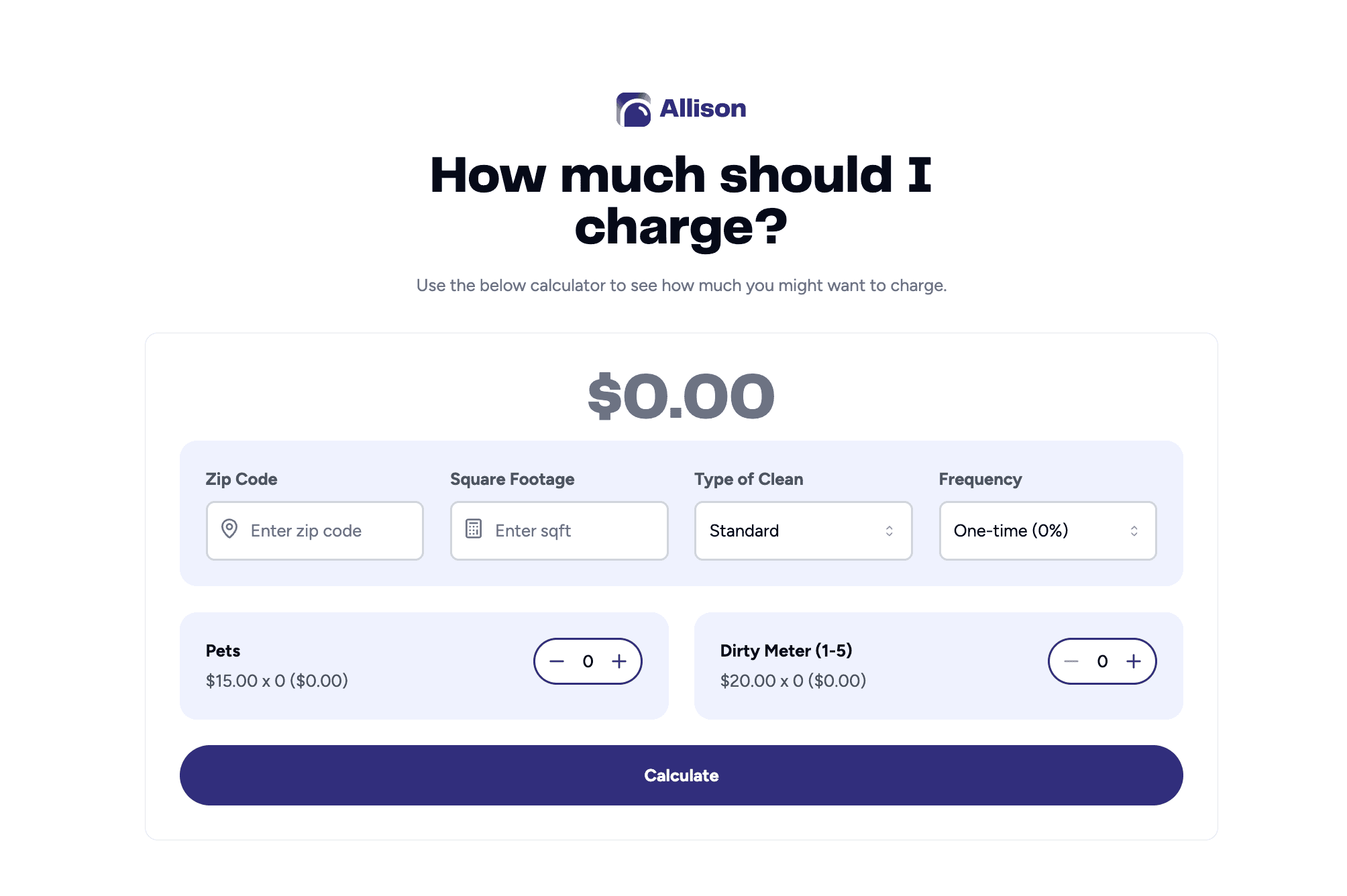
Use the Allison Cleaning Pricing Calculator
Rather than calculating every quote manually, Allison's free Pricing Calculator helps estimate pricing based on:
ZIP code
Home size
Cleaning type
Cleaning frequency
Home condition
Pets
Instead of spending 10–15 minutes building every estimate, you can generate one in seconds.
Try the free Pricing Calculator and start building quotes with confidence.
Frequently Asked Questions
How much should I charge to clean a 2,000 sq ft house?
Most cleaning businesses charge somewhere between $200 and $350 for a standard residential cleaning, depending on the local market and condition of the home.
Is hourly or flat-rate pricing better?
Flat-rate pricing is generally preferred because customers know exactly what they'll pay before the appointment.
Should deep cleans cost more?
Yes.
Deep cleans require significantly more labor and should always be priced above recurring maintenance cleanings.
Should I charge extra for pets?
Many companies do because pet hair and additional cleaning increase labor.
What is the easiest way to calculate pricing?
Using a consistent pricing formula—or a pricing calculator—helps ensure every estimate is accurate and profitable.
Final Thoughts
Pricing is one of the most important systems in your business.
When your pricing is consistent, profitable, and easy to explain, everything else becomes easier—from quoting to scheduling to long-term growth.
If you're still estimating jobs manually, start with a repeatable pricing system and refine it over time.
Your future business will thank you.
Run your cleaning business like the owner you already are.
Book a Demo

See more practical cleaning advice in Google
Add Allison as a preferred source so our guides are more likely to appear in your Google results.