The Problem With "Going Rate" Pricing
Most cleaning business owners price deep cleans the same way: check what competitors charge, pick a number in the middle, and hope for the best.
This is how you end up working 12-hour days and wondering where the profit went.
Deep cleans take 2-4x longer than regular maintenance cleans. They require more supplies, more labor, and more expertise. Yet many owners charge only a small percentage more than their standard rate—leaving serious money on the table.
Here's how to price deep cleans so you actually make money.
Know Your Real Costs First
Before you set any price, you need to know what a deep clean actually costs you to deliver. Not a guess. The real number.
Labor cost per hour: Take your cleaner's hourly wage and add 20-30% for taxes, insurance, and workers comp. If you pay $18/hour, your true labor cost is closer to $22-23/hour.
Average deep clean time: Track your last 10 deep cleans. How long did each take? For most residential deep cleans, expect 4-6 hours for a standard 3-bedroom home.
Supply cost per job: Deep cleans use more product—degreasers, heavy-duty solutions, more microfiber cloths. Budget $15-25 per deep clean in supplies.
Your break-even formula:
(Labor cost per hour × Hours) + Supply cost = Minimum price
Example: ($22 × 5 hours) + $20 supplies = $130 minimum
That's your floor. You haven't made a dime of profit yet.
Add Your Profit Margin
A healthy cleaning business runs on 25-35% profit margins. Below 20%, you're one bad month away from trouble.
To hit 30% profit on that $130 deep clean:
$130 ÷ 0.70 = $186
Round up to $189 or $199. That's a real price based on real numbers—not a guess based on what you think the customer can pay.
The Capacity Pricing Rule
Here's what most owners miss: your price should change based on how booked you are.
Under 60% capacity: You need work. Price competitively to fill the schedule.
60-75% capacity: Healthy range. Hold your standard pricing.
75-85% capacity: Raise prices 10-15%. You can afford to be selective.
Over 85% capacity: Raise prices 20%+ or add staff. Turning away work at your current price means you're undercharging.
When you're fully booked, every job you take means turning another one down. Price accordingly.
Square Footage Pricing That Works
Flat rates are easy to quote but hard to profit from. A 1,200 sq ft apartment and a 3,500 sq ft house with kids and pets shouldn't cost the same. We built a free tool that helps give you an idea of what you should consider your starting rate based on the zip code
Adjust for condition. A move-out clean in a home that hasn't been touched in a year costs more than a deep clean for someone who cleans weekly.
Track What You Actually Make
Pricing means nothing if you don't track whether you're hitting your margins. After every deep clean, know your actual profit—not your hoped-for profit.
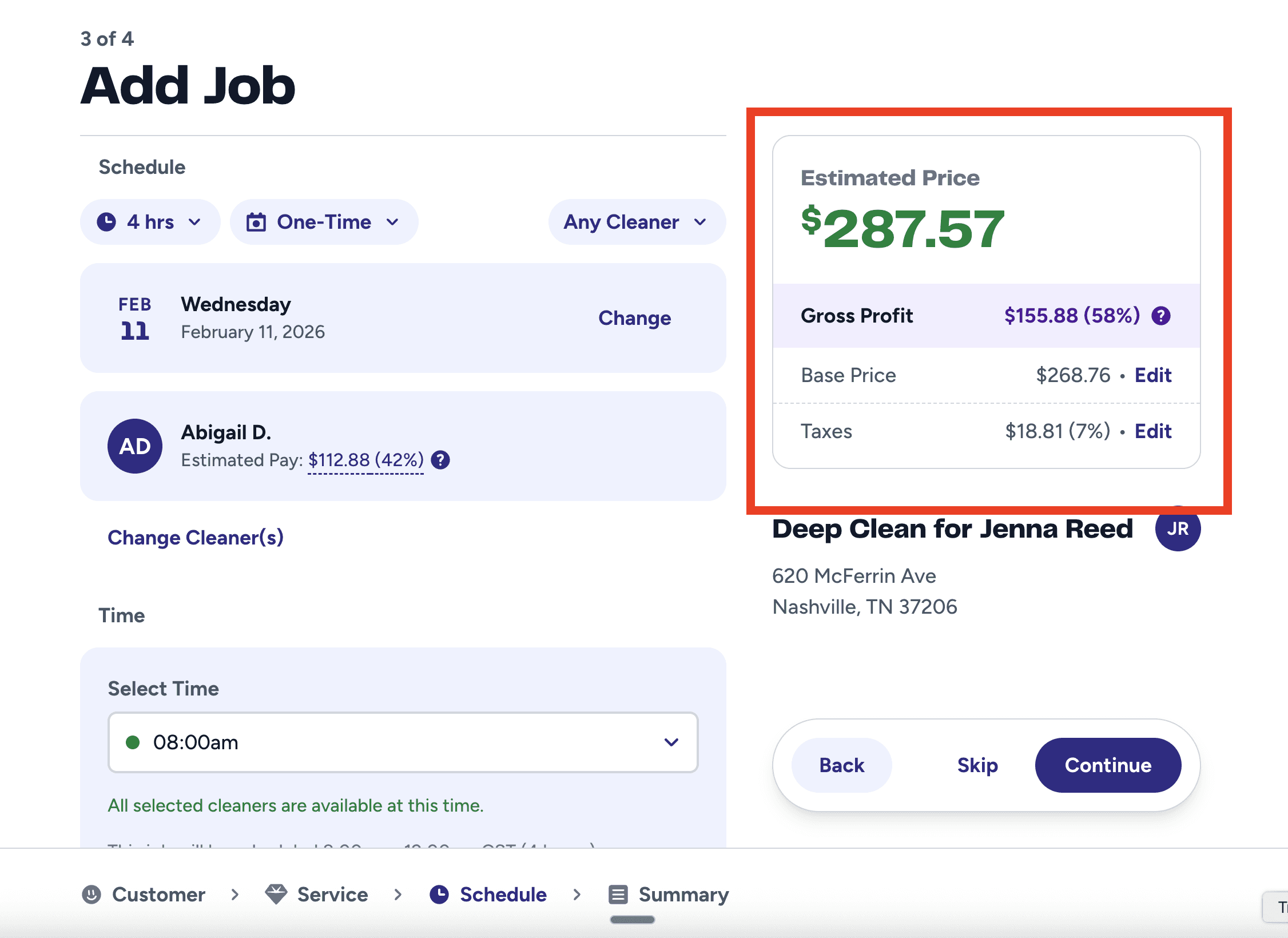
Software like Allison shows you gross profit per job automatically. You see exactly what you made after labor and supplies, on every single clean. No spreadsheets, no guessing.
When you can see that Tuesday's deep clean made $67 profit but Thursday's lost $12, you fix the problem before it becomes a pattern.
Stop Undercharging
Deep cleans are premium services. They require skill, time, and real expertise. Price them that way.
Run your numbers. Know your costs. Add a real margin. Then raise your prices when demand proves you should.
The owners who do this don't wonder where the profit went. They see it on every job.
FAQ
How much should I charge for a deep clean per square foot?
Most residential deep cleans fall between $0.18-0.25 per square foot, but this varies by market and condition. A 2,000 sq ft home would be $360 (minimum!). Always calculate your actual costs first.
Should I charge hourly or flat rate for deep cleans?
Flat rates are easier for customers but riskier for you. If you use hourly, quote a range (4-6 hours at $55+/hour). If you use flat rates, build in buffer for worst-case scenarios.
How do I know if I'm charging enough?
Track profit per job. If your average deep clean profit margin is below 25%, you're undercharging. If customers never push back on price, you're definitely undercharging.
When should I raise my deep clean prices?
When you're booked at 75%+ capacity for 4+ weeks straight. If you're turning down work, your prices are too low for current demand.
Run your cleaning business like the owner you already are.
Book a Demo

See more practical cleaning advice in Google
Add Allison as a preferred source so our guides are more likely to appear in your Google results.